
How to Check Criminal History in Lafayette County
Start with the record that best fits the question. Missouri Case.net is free and shows public Lafayette County charges, hearings, docket entries, judgments, and dispositions. The Circuit Clerk supplies public documents that are older or not visible online. The sheriff or city police department keeps the first incident and arrest report, while the detention center holds the booking and custody file. MACHS, the Missouri Automated Criminal History Site, is the paid state repository search. It is broader than one county docket but returns only open Missouri criminal history.
Gather the full name, exact spelling, birth date, former names, and any case or report number before searching. A case number is the strongest Case.net key. MACHS matches at least two identity components, and using both date of birth and Social Security number can improve a name match. Fingerprints provide positive identity when a personal self-review or authorized check calls for that level of certainty.
- Search Case.net by name, filing date, case number, or scheduled hearing, then select Lafayette County or the 15th Judicial Circuit.
- Open the case number and compare the court, parties, filed charges, status, hearings, and judgment rather than relying on the result list.
- Ask the Circuit Clerk for public documents or older files that cannot be viewed remotely, giving the exact case number when possible.
- Contact the arresting agency for its report and the detention center for a releasable Lafayette County booking record.
- Order MACHS for statewide open history, or use the fingerprint portal when an identity-confirmed response is appropriate.
Case.net’s four public search routes answer different questions. The case-number route is strongest when the exact number is known. Name searches can miss a protected person, filing-date searches find cases rather than arrests, and hearing calendars can change.
| Case.net Route | Useful Controls | Main Limit |
|---|---|---|
| Litigant Name | Name, court, year, and case type | Only identified litigants appear |
| Filing Date | Court, date range, and case type | Does not find an unfiled arrest |
| Case Number | Court and exact case number | Requires the correct number |
| Scheduled Hearings | Court, date, judge, division, and case controls | Schedules may change |
Four Lafayette County Record Trails
Lafayette County criminal records follow four main trails. A police or sheriff report describes the event and the officer’s action. A jail file records intake, custody, bond, and release. A court file begins when a prosecutor or municipal authority files a charge. MACHS compiles reportable arrest and disposition data sent to the Missouri State Highway Patrol. One trail may move before another. A booking can exist before a case is filed, and a dismissed case does not erase the originating report or booking by itself.
The official Lafayette County government directory routes readers to the county offices that hold these records.

The county entry page helps separate court, sheriff, and prosecutor channels before a request is sent. A useful flow is: agency report → detention booking → prosecutor filing → court disposition → repository update. No result at one point disproves a record at another.
Official Missouri Background Checks
The Missouri State Highway Patrol Criminal Justice Information Services Division runs the state Central Repository. Its MACHS criminal record products include a public personal-identifier name search and a fingerprint search portal. The name search costs $15 plus the payment processing charge. An optional notarized response adds $5. It can return Missouri convictions, recent arrests, pending filed charges, an active suspended imposition of sentence, and a current state registry match when those items are open.
MACHS omits closed Missouri records and FBI history. The ordinary published fingerprint components are $20 for a state-only search, $13.25 for an authorized FBI component, and a $12 IDEMIA collection fee, although purpose-specific rates can differ. Enrollment uses a proper registration code and an IDEMIA or IdentoGO appointment. A current Lafayette County fingerprint site was not verified, so search by ZIP and confirm the location before travel. The FBI Identity History Summary is a separate subject-only federal self-review, not a county search.
| Official Product | Published Cost | Scope |
|---|---|---|
| MACHS name search | $15 plus processing | Open Missouri repository history |
| Notarized response | $5 additional | Optional notarization of response |
| State fingerprint component | $20 ordinary rate | Identity-confirmed Missouri search |
| FBI component | $13.25 when authorized | Authorized federal component |
| IDEMIA collection | $12 ordinary rate | Fingerprint capture |
Lafayette County Records Request Form
The sheriff has no separate public records portal, clearance product, posted copy schedule, or named records manager. Lafayette County’s cross-department request form is the verified online fallback. A requester chooses the custodian, including Sheriff or Circuit Clerk, gives contact details, describes the record, and selects inspection, electronic copies, paper copies, or no preference. Email, mail, and an in-person request to the proper office also remain valid channels.
The county’s department-routed Sunshine request form shows those fields and delivery choices.
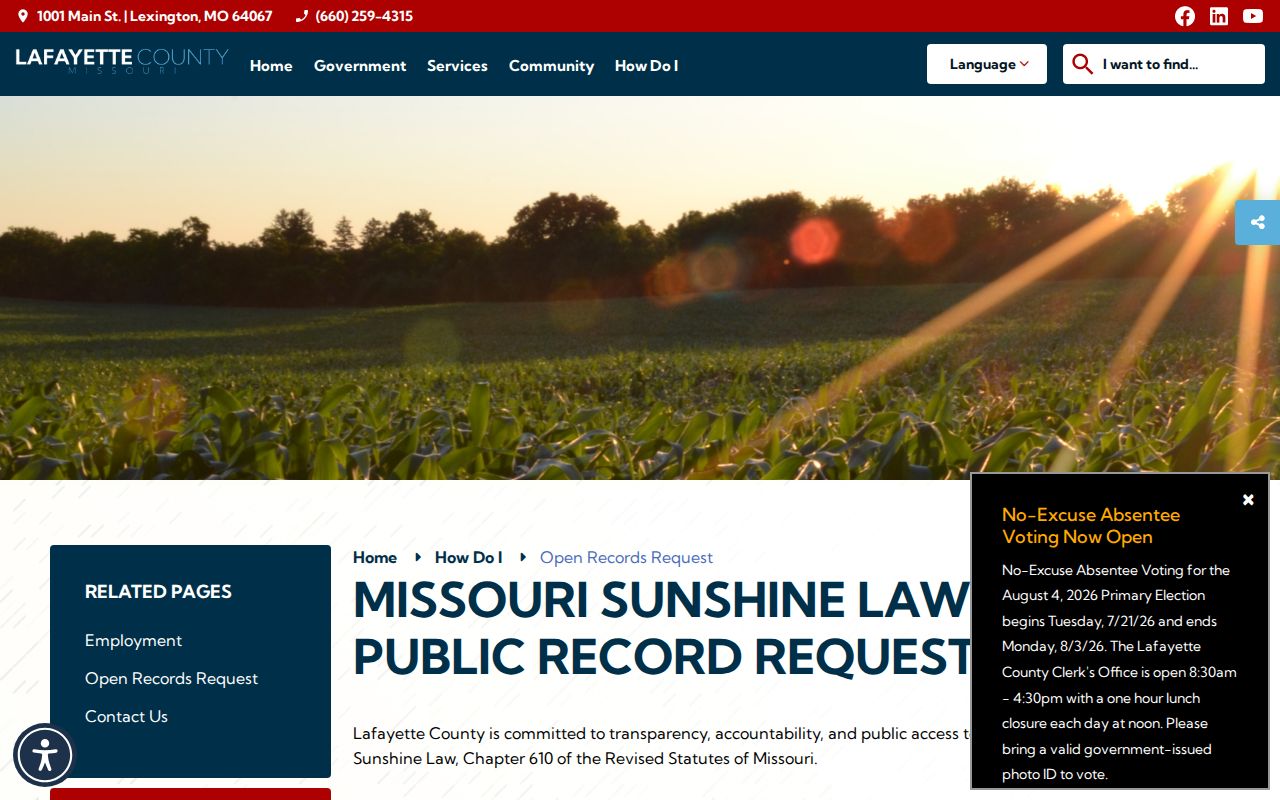
The form matters most when no public database exists. Ask for each item by name, such as the incident report, arrest report, booking sheet, warrant return, or dispatch event. Include a report number, date, time, place, involved agency, and requested format. Standard pages may cost no more than ten cents each, plus actual research time charged at the rate of the lowest-cost capable employee. Electronic or special production may be charged at actual cost, and prepayment may be required.
Missouri’s three-business-day rule is a response rule, not a promise that every file will be produced in three days. If production takes longer, the custodian should explain the delay and give the earliest time and date. Requesting an estimate first can prevent surprise costs.
Types of Criminal Records
Each Lafayette County criminal record has a distinct source. Incident reports state the first known facts, while investigative reports add interviews, evidence, and analysis. Arrest reports describe restraint, a summons, or booking. The detention center creates the booking record. Prosecutors create charging instruments, and the Circuit Clerk maintains pleadings, orders, dockets, judgments, and financial entries. MSHP compiles reportable state history, and MODOC separately maintains prison and adult supervision information.
Public access changes with record status. An active investigation may remain closed even when basic incident facts are open. Juvenile, victim, protected-party, personal identifier, and expunged data are restricted. A registry listing is a statutory registration record, not a full criminal history and not an individual risk finding.
- Arrest and booking records state the agency action, intake, initial charge, bond, custody, and release facts available by law.
- Criminal court case files show allegations as filed, hearings, motions, pleas, disposition, and sentence.
- Repository histories connect reported Missouri arrest cycles with later reported outcomes, subject to open-record limits.
- Warrant records begin with a court and may be entered or served by law enforcement.
- Custody, supervision, and registry records answer narrower questions about jail, prison, probation, parole, or statutory registration.
Lafayette County Record Counter
The 1847 Lafayette County Courthouse at 1001 Main Street remains the Circuit Court setting, but the public clerk counter is one block south. Circuit Clerk Kim Mason’s office is in Lafayette Hall at 116 South 10th Street, P.O. Box 10, Lexington. It is open Monday through Friday from 8:00 a.m. to 4:30 p.m., except state holidays. The phone is 660-259-6101, and the clerk accepts record questions by email at Lafayette.email@courts.mo.gov.
This split can trip up a first visit. The Circuit Court courtroom is on the courthouse second floor. Associate Circuit and Probate courtrooms are on Lafayette Hall’s second floor, where the clerk also maintains the files. Email can be used for a public record question or request, but an attachment sent to the clerk’s email is not a court filing. Staff may explain procedure but cannot give legal advice.
Circuit Clerk
Lafayette Hall
116 S. 10th Street
Lexington, MO 64067
660-259-6101
Monday-Friday, 8:00-4:30
Sheriff and Detention
107 S. 11th Street
Lexington, MO 64067
660-259-3622
Jail: 660-259-6682
Prosecuting Attorney
Lafayette Hall
116 S. 10th Street
Lexington, MO 64067
660-259-6181
Note: Confirm current security or access rules with the clerk before bringing recording equipment or requesting special accommodations.
What a Lafayette County Criminal Record Shows
The contents depend on the custodian. A MACHS repository response groups identity data with reported arrest cycles and dispositions. Case.net centers on a case number, court, parties, filed charges, docket events, hearings, judgment, and financial entries. A Lafayette County booking file focuses on intake and custody. Public versions should exclude Social Security numbers, protected addresses, victim and minor data, sealed warrants, and other confidential matter.
| Name & Identifiers | Names, aliases, birth date, sex, race, Missouri SID, and sometimes an FBI number, subject to public limits. |
|---|---|
| Arrest / Booking Data | Agency, date, place, booking number, intake, initial charge, bond, and release or custody status. |
| Charges & Statutes | Alleged offenses at arrest or charges later filed by the prosecutor, which may differ. |
| Disposition | The result of each charge, such as conviction, acquittal, dismissal, or nolle prosequi. |
| Sentence | The court order after guilt, including confinement, probation, restitution, or other terms. |
| Custody / Supervision Status | County jail custody, state prison, probation, parole, or conditional release when held by the proper agency. |
Read charges and outcomes separately. An arrest charge can change before filing, and a filed charge can be amended or dismissed. “Disposition” means the result of a charge. “Suspended imposition of sentence,” often shown as SIS, means the court did not impose a sentence while probation was completed. “Suspended execution of sentence,” or SES, means a sentence was imposed but its execution was suspended during probation.
Lafayette County Jail Record Fallback
Lafayette County has no verified public inmate roster or booking log. For current custody, call the detention center at 660-259-6682 or the sheriff at 660-259-3622. A precise Sunshine request can seek a releasable booking record. MODOC Offender Search is the correct statewide channel only after a person enters state custody or supervision. It is not a substitute for the county jail.
The Lafayette County Sheriff’s official page provides current office contact and alert routes.

The sheriff page does not publish a warrant tool, Most Wanted list, app-only search, or current jail population. Nixle alerts are available, but no records app was verified. For a warrant concern, check Case.net for public docket activity, contact the issuing circuit or city clerk, call the sheriff, and confirm with the city court when an ordinance case is involved.
The 126-bed detention center has five inmate pods and one work-release pod. Its history says the first inmates entered on September 23, 2004, while another line calls completion 2005. Those two official dates should be read as a documented transition, not forced into one date. Historic operation figures from 2016 and 2017 show crowding, but they are not current crime rates or current population counts.
Public Access Laws
Missouri Sunshine Law starts from the rule that government records are open unless a law closes them. That does not make every Lafayette County criminal record public. Active investigative work, juvenile files, protected victim facts, personal identifiers, expunged files, and court-confidential material can be withheld or redacted. The initial incident and arrest record often begins open, but an uncharged arrest generally closes after 30 days, subject to the limits and exceptions in state law.
Key Statutes:
Chapter 610 RSMo sets Missouri’s open-record framework and its exceptions.
RSMo 610.100 addresses incident, arrest, and investigative records, including the 30-day uncharged-arrest rule.
RSMo 43.506 defines reportable offenses sent to the MSHP Central Repository.
RSMo 610.120 closes expunged records while preserving limited statutory access.
RSMo 610.140 governs the general petition, eligibility, timing, and effect of expungement.
A request should be narrow enough for the office to find the record. Closed parts may be removed while open parts are produced. Court records also follow judiciary rules, so the county’s executive-branch request form does not override the court’s own access process.
Lafayette County Charge Record Pipeline
An arresting officer’s report does not become a court judgment. The Lafayette County Prosecuting Attorney reviews agency investigations and may file an information, which is a formal charging document. A grand jury may instead return an indictment. The clerk then opens the case file, and Case.net can show public docket activity. Charges remain allegations until the court reaches a result. A jail’s booking charge, the prosecutor’s filed charge, and the final judgment can all differ. The Lafayette County Prosecuting Attorney’s office page describes its role in matters ranging from traffic cases through homicide.
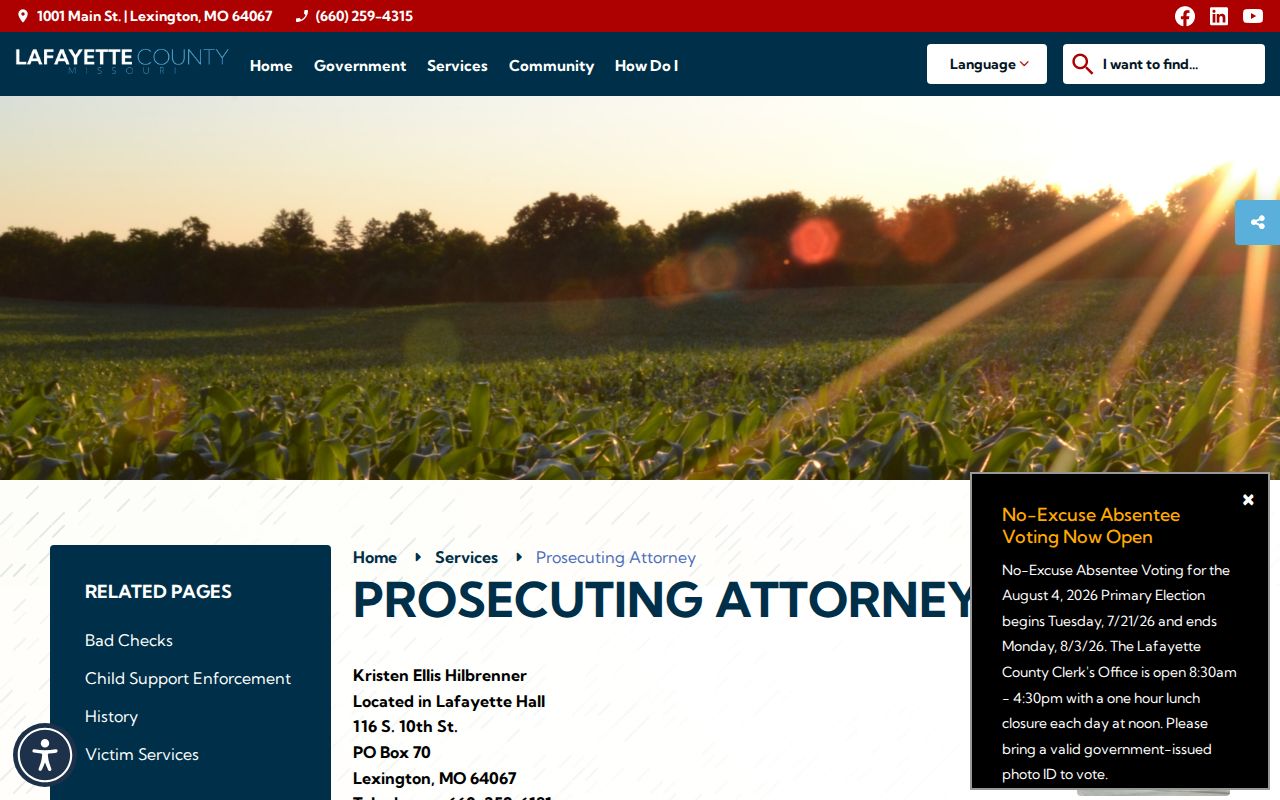
The office is at Lafayette Hall, the same 10th Street building as the clerk. Custody questions go to detention, dates and docket questions go to the court, and legal questions go to counsel. That division keeps the record trail clear and prevents a request from landing with an office that does not hold it.
County victim services can provide hearing and disposition notices, court support, restitution help, and recovered-property assistance to eligible participants. The official victim services description lists those Lafayette County programs.
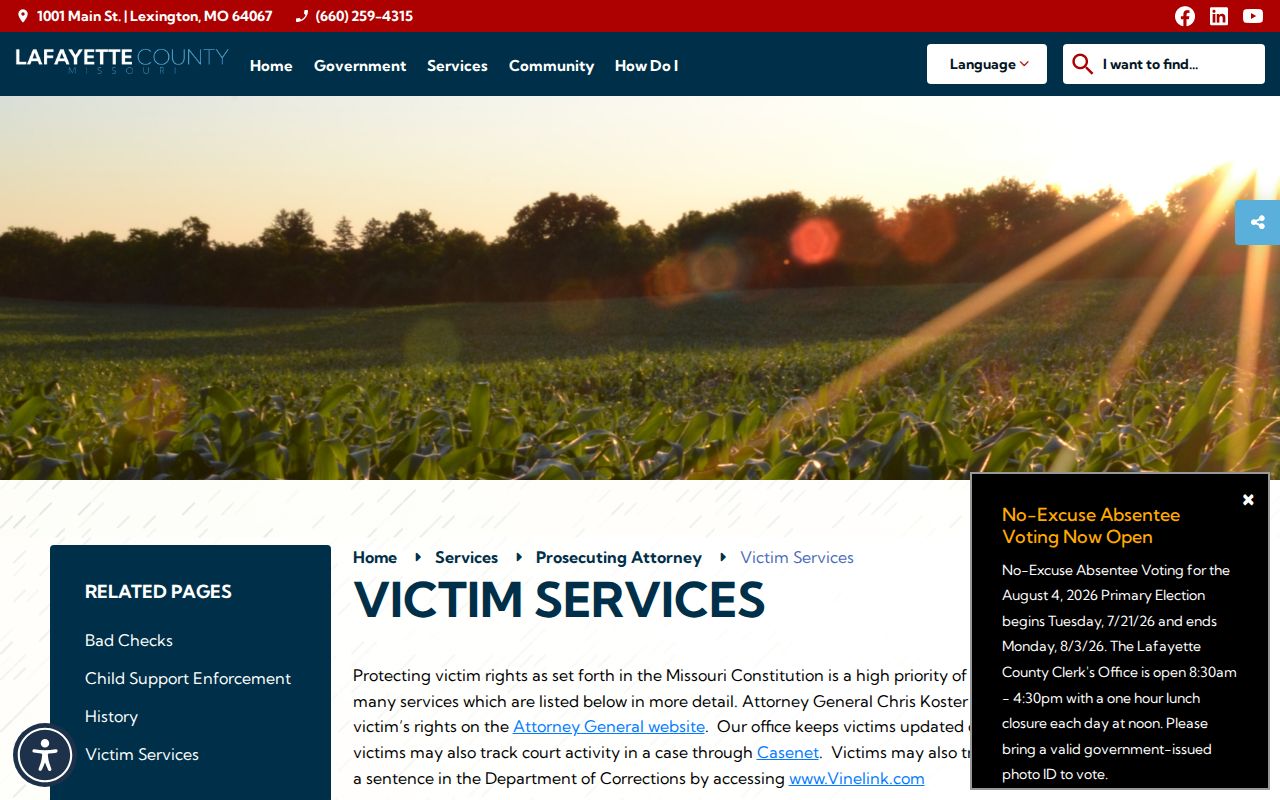
Those services do not replace the public docket, but they explain why some notice and support records remain with the prosecutor rather than the clerk or sheriff.
Lafayette County Criminal Record Classes
A Missouri class label describes the legal range assigned to an offense, not the sentence a Lafayette County judge will impose. Class A felonies carry ten to thirty years or life. Class B felonies carry five to fifteen years, while Class C felonies carry three to ten. A Class D felony carries no more than seven years, and a Class E felony no more than four. Enhancements and persistent or dangerous offender findings can change the result.
Misdemeanor ranges are shorter. Class A permits no more than one year, Class B no more than six months, and Class C no more than fifteen days. Infractions carry no imprisonment under this classification scheme. Municipal violations are ordinance cases even when the conduct resembles a state misdemeanor. Always read the filed charge, judgment, and sentence together rather than predicting an outcome from the class alone.
- Charge
- An allegation filed for court action, not proof of guilt.
- Disposition
- The result of a charge, such as conviction, dismissal, or acquittal.
- Sentence
- The court’s order after guilt, which may include custody, probation, or other terms.
- Municipal violation
- A city ordinance case handled through a municipal division rather than a state felony prosecution.
Sealed, Expunged & Restricted
Missouri expungement closes qualifying records rather than destroying every agency copy. Juvenile files, protected-party information, active investigations, personal identifiers, and expunged records do not appear like an ordinary adult public docket. MACHS omits closed Missouri records. Even after relief, RSMo 610.120 permits access for named criminal justice and statutory purposes.
General relief under RSMo 610.140 is detailed and offense-specific. The usual wait after an authorized disposition is three years for a felony and one year for a misdemeanor, ordinance violation, or infraction. Arrest-only relief may have an 18-month minimum when no charge was filed. The person must meet eligibility terms, have no pending charge, pay required obligations, and name each record holder that should be bound. Class A and dangerous felonies, registration-triggering sex offenses, and other listed offenses are excluded.
The Missouri CR360 petition asks for the court, case, offenses, dates, and all agency defendants. A $250 statutory surcharge applies, plus Lafayette County’s ordinary filing costs, which were not posted as one total. An omitted record holder may not be bound by the order. After relief, verify closure with the court and an MSHP self-review. A pardon and an expungement are not the same remedy.
Lafayette County Supervision Records
Adult probation and parole are state-run in Missouri. The Division of Probation and Parole supervises people placed on probation by a circuit court, released by the Missouri Parole Board, placed on conditional release, or transferred through the Interstate Compact. Case.net shows the judgment that imposed probation. MODOC data may show current custody or supervision. A field officer remains the best source for a specific status question.
The Missouri probation and parole division page explains that statewide structure.
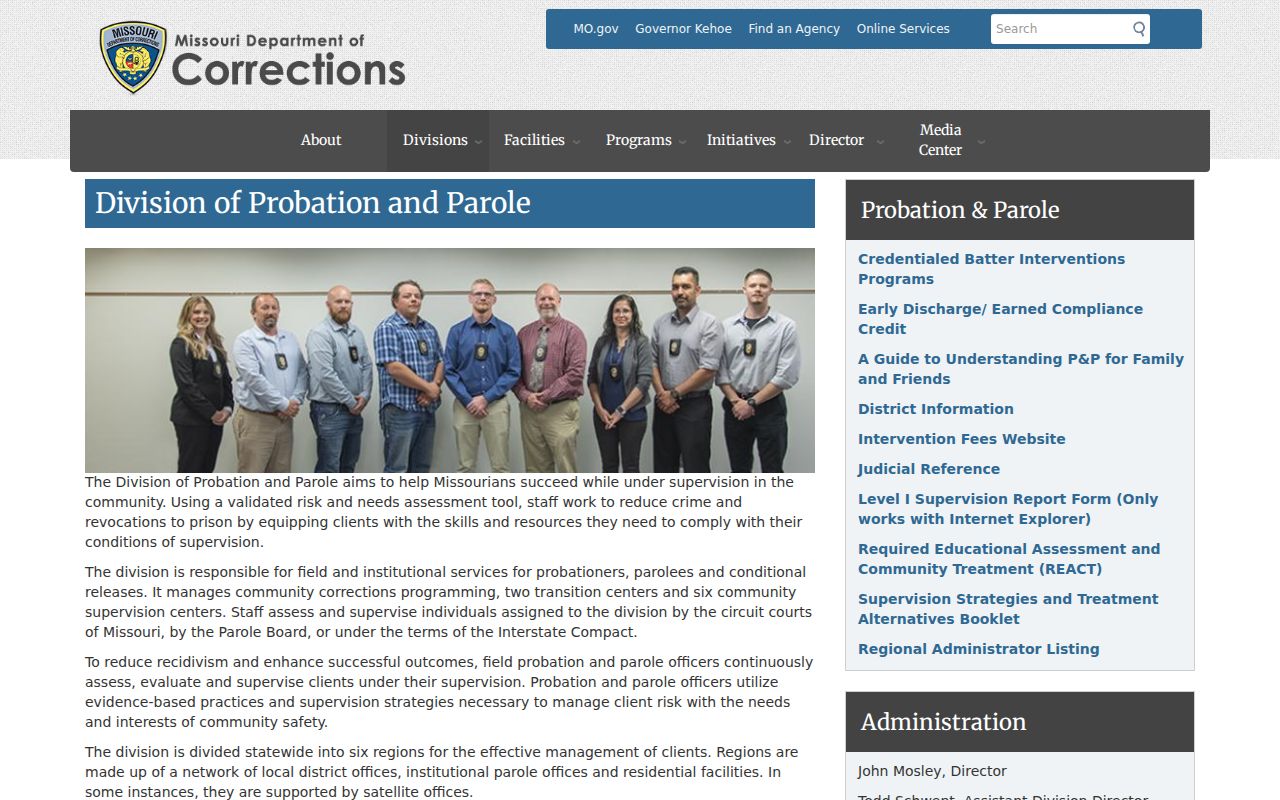
This state layer should not be confused with the Lafayette County jail. Search MODOC by a correctly spelled full name and offender number when known, then compare the result with the Lafayette County court judgment. MODOC warns that converted or self-reported fields can be incomplete. A “no result” needs the same caution as any other criminal history search.
Lafayette County Court Record History
The county’s record geography reflects its history. The Greek Revival courthouse opened in 1847 and is still used as a courthouse. A cannonball scar from the 1861 Battle of Lexington remains in a front column. Yet the working clerk counter is now at Lafayette Hall. That contrast explains why a record seeker can retrieve a public case file on 10th Street and attend a Circuit Court hearing at 1001 Main Street.
The Battle of Lexington State Historic Site preserves the setting tied to the courthouse’s surviving war damage.
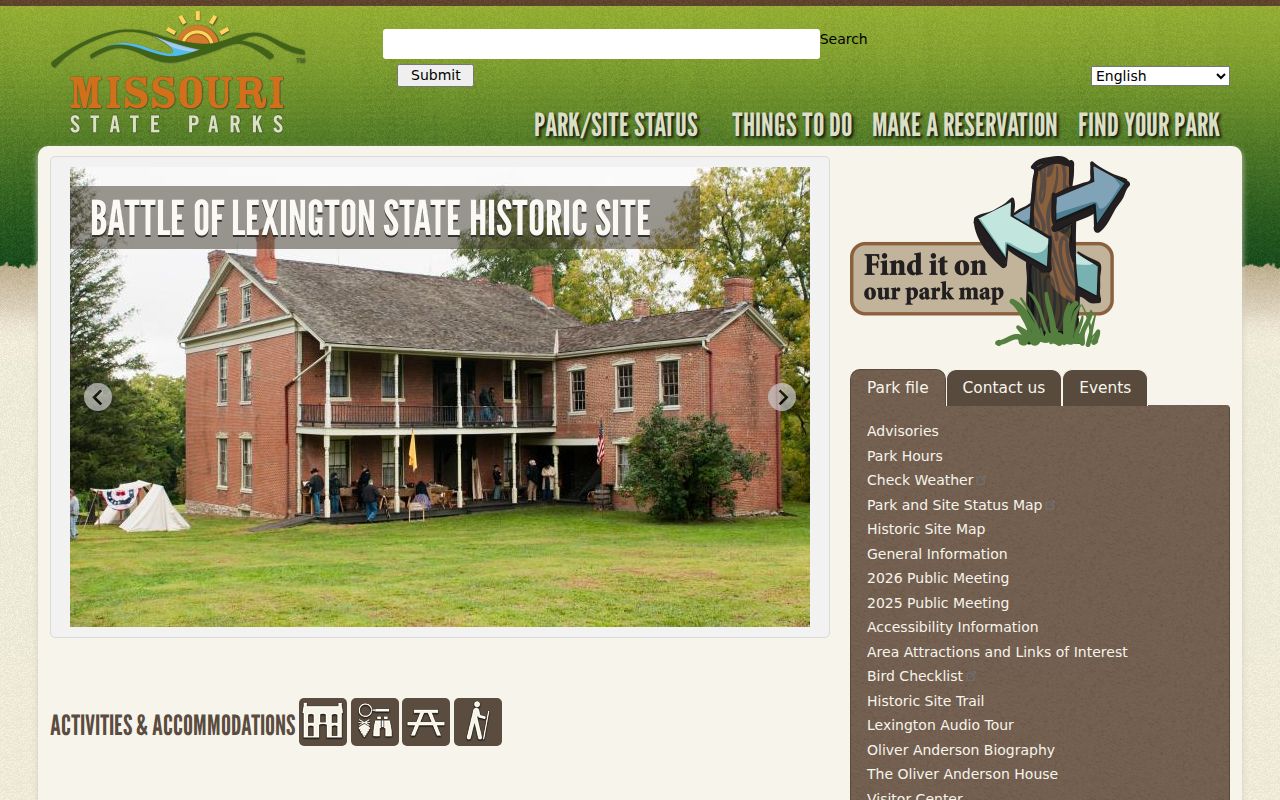
The physical story is more than local color. It is a practical reminder that the courtroom, clerk counter, sheriff, detention center, and prosecutor occupy distinct spaces and hold distinct records. Sending one broad request to “the courthouse” can miss the proper custodian.
Local law enforcement history also includes Minnie Mae Talbott, who won a 1919 special election after Sheriff Joseph C. Talbott was killed in the line of duty. The official sheriff history calls her the first woman elected sheriff in the United States. Modern cooperation continues through a multiagency CAT unit shared by the sheriff, Higginsville, Odessa, and Concordia for high-risk warrants and other critical incidents.
Criminal Records by City in Lafayette County
City police departments create their own incident and arrest reports, while municipal courts handle local ordinance and traffic matters assigned to them. Odessa, Higginsville, and Lexington each publish different office contacts and court arrangements. None publishes a verified police blotter, booking portal, warrant search, or mobile records app. Begin with the city police contact for an agency report, use the municipal court or Case.net for filed matters, and check Lafayette County detention when custody may have moved beyond the city.
Odessa Criminal History
Population 5,721 · Police records start on First Street, while municipal court records are kept through the Second Street city office.
Higginsville Criminal History
Population 4,770 · Police requests use phone, fax, mail, or the counter, and municipal court meets at City Hall.
Lexington Criminal History
Population 4,568 · Police office hours and 24-hour dispatch use separate numbers, while ordinance cases flow through the municipal division.
The population figures are official July 1, 2025 estimates. They establish the county’s three largest incorporated cities, not crime rankings. Historical arrest totals should never be treated as current crime rates, unique people, or convictions.
Lafayette County Dispatch Record Split
One emergency response can create records in two local systems. Higginsville Central Dispatch took over county 911 answering in 2018. The Lafayette County Sheriff restored its own 24-hour dispatch in 2023, but Higginsville still answers 911 and transfers sheriff calls. As a result, the responding report may be held by the sheriff while call audio or a computer-aided dispatch entry may begin with Higginsville.
Ask for each medium by name. A request for only the “police report” may not reach the 911 audio, CAD event, body-camera file, crash record, or evidence photographs. State the call date, time, place, responding unit, and type of file sought. If the first office does not hold it, ask which dispatch center or agency does.
Note: The county has no consolidated police-record portal, so the responding agency and dispatch custodian must be identified separately.