
Criminal Cases in the Lafayette County Courts
Lafayette County belongs to Missouri’s 15th Judicial Circuit. Division 1 Circuit Court handles felony prosecutions. The associate circuit court handles misdemeanors, traffic matters, and preliminary felony work assigned by state law. City municipal divisions deal with ordinance cases, so a ticket issued under a city code may remain with the city division even though its public docket appears in the state system.
The Lafayette County Circuit Clerk is custodian of circuit and associate court files. A court file begins when a prosecutor files a complaint, information, or indictment. It then gathers the court’s own record of pleas, motions, service, hearings, judgment, financial entries, and sentence. The incident report stays with the arresting agency, and a jail booking sheet stays with the custodian of the jail record. Those records may concern the same event, but none replaces the Lafayette County court case file.
The county’s general court information describes the clerk’s work with Missouri’s Judicial Information System and the public counter. It is the local source for understanding why the clerk, not the sheriff, holds filed court papers.
Two Lafayette County Court Buildings
A common local mistake is going to the historic courthouse when the goal is to request a file. The Lafayette County Circuit Clerk works at Lafayette Hall, 116 South 10th Street, P.O. Box 10, Lexington, Missouri 64067. The counter is open Monday through Friday from 8:00 a.m. to 4:30 p.m., except state holidays. The office can be reached at 660-259-6101, by fax at 660-259-6148, or at Lafayette.email@courts.mo.gov.
The Circuit Court courtroom is on the second floor of the 1847 courthouse at 1001 Main Street. Associate Circuit and Probate courtrooms are on Lafayette Hall’s second floor. Local sessions ordinarily begin at 9:00 a.m.; jury-trial counsel and parties report at 8:30 unless told otherwise. Thus, a reader may collect a Lafayette County case record at Lafayette Hall and attend the related hearing across the block.
The official clerk page shows the office details used for Lafayette County court record requests.
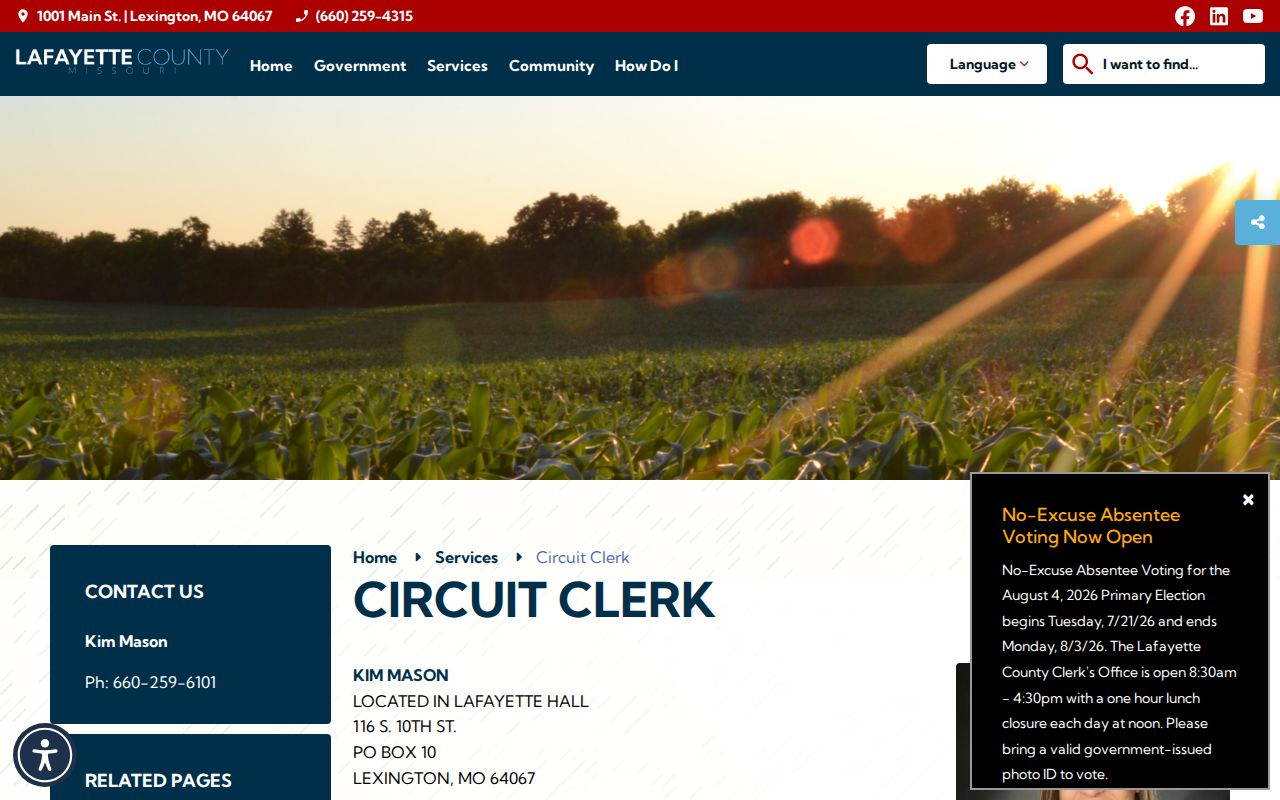
The image reinforces the local split between the file counter and the courtroom location.
How to Search Case Records
Missouri Case.net is the official statewide public index for Lafayette County criminal cases. Basic docket searching is free and does not require an ordinary user account. A case number is the strongest key because names can be shared, spelling can vary, and protected parties may not appear in litigant results.
- Open Case.net and select Litigant Name, Filing Date, Case Number, or Scheduled Hearings and Trials.
- Choose Lafayette County or the 15th Judicial Circuit, then narrow by year or case type when those controls appear.
- Open the case-number link and note the case header, court location, public charge, and current status.
- Read docket and hearing entries separately. Treat a filed charge as an allegation until the judgment shows its disposition.
- Ask the Circuit Clerk for older material, a public document not shown online, or the available copy and certification options.
| Search Route | Confirmed Controls | Best Use | Limit |
|---|---|---|---|
| Litigant Name | Name, court, year, case type | When the case number is unknown | Protected parties may not appear |
| Filing Date | Court, date range, case type | Finding cases filed in a known span | Finds cases, not arrests |
| Case Number | Court and exact number | Opening a known Lafayette County file | Requires the correct number |
| Scheduled Hearings | Date range and available court controls | Checking a public court calendar | Schedules can change |
Missing Lafayette County Court Documents
A docket entry is a clerk’s dated note of activity, not proof that the public can download the filed paper. Case.net may display a hyperlink beside an event when an attachment is available to that user. If no link appears, first confirm that the entry is public. Then give the Circuit Clerk the Lafayette County case number, document title, and filing date so staff can identify the record.
Public users may inspect public court documents on courthouse equipment when court staff log them on. The clerk also accepts questions and record requests by phone, email, mail, and at the Lafayette Hall counter. Email attachments do not count as court filings, and staff cannot give legal advice. No verified local price for plain or certified court copies was found, so request a cost estimate before placing an order.
Note: A missing download link does not establish that the document is sealed or absent from the clerk’s public file.
What the Case File Shows
The public Lafayette County court file organizes the prosecution by case, not by booking event. Read the header for identity and court placement, the charge area for allegations, the docket for sequence, and the judgment for the result. Public financial entries may show court-ordered amounts, but they should be read with the judgment and sentence.
| Case Number & Court | The unique file number, case style, type, division, and Lafayette County court location. |
|---|---|
| Charging Document | The complaint, information, or indictment that states charges filed by the prosecutor. |
| Docket Entries | The clerk’s dated record of filings, orders, appearances, service, and other case activity. |
| Hearing Dates | Public settings for arraignment, pretrial work, plea, trial, or sentencing, subject to change. |
| Disposition & Judgment | The outcome of each public charge, such as conviction, acquittal, dismissal, or nolle prosequi. |
| Sentence & Conditions | The court’s order after guilt, including custody, probation, restitution, or other public terms. |
A public judgment index can include the defendant, case number, judgment or sentence date, and a summary. Confidential birth dates, Social Security numbers, victim or minor identifiers, sealed warrants, and expunged data are not part of the ordinary public view.
Read Lafayette County Case Results
Missouri docket terms show different points in the case. A dismissal ends a charge without a conviction. An acquittal is a not-guilty outcome. Nolle prosequi means the prosecutor formally chose not to continue a charge. A suspended imposition of sentence, often called SIS, means no sentence is imposed while probation is completed; its public status can change after completion under Missouri closure rules. A suspended execution of sentence, or SES, means a sentence was imposed but its execution was suspended during probation.
- Arraignment
- The hearing at which charges are formally presented and a plea is addressed.
- Docket entry
- The clerk’s chronological note of activity in the Lafayette County criminal case.
- Disposition
- The result of a charge or case, which must not be confused with the charge itself.
- Judgment
- The court’s formal determination that records the adjudicated result.
- Bench warrant
- Court process directing an arrest, often after nonappearance or violation.
Read charges and judgments separately. A plea agreement is a proposed negotiated resolution subject to court action, while the judgment records what the court ultimately did.
Stages of a Criminal Case
A Lafayette County criminal case starts as a court record when charges are filed. The court then addresses the accused person’s plea and release status at arraignment or an early appearance. Pretrial entries can include counsel appearances, discovery-related activity, motions, continuances, and settings. The case may resolve by plea, dismissal, or trial. Judgment supplies the disposition, and sentencing records the court’s order when guilt results.
Case flow: Charges Filed → Arraignment → Pretrial → Plea or Trial → Disposition → Sentencing
An arrest may exist before any Lafayette County case appears because law enforcement creates its record before a prosecutor decides what to file. Conversely, the booking charge may differ from a later filed, amended, dismissed, or adjudicated charge. For custody details, use the record’s proper custodian; the Lafayette County arrest history process explains the separate agency and jail channels.
Track Lafayette County Criminal Cases
Case.net’s Track This Case feature can send email or text notices tied to a public case. Begin from the Lafayette County case page and follow the official tracking steps. The feature is useful for changes in scheduled events, but it does not replace the docket, an official notice, or direct confirmation with the clerk. Fine Collection Center matters are excluded from tracking.
The public case index is one part of Missouri’s record system. The official MODOC Offender Search is a different tool for state incarceration and adult supervision. It is not a source for the full Lafayette County court docket.
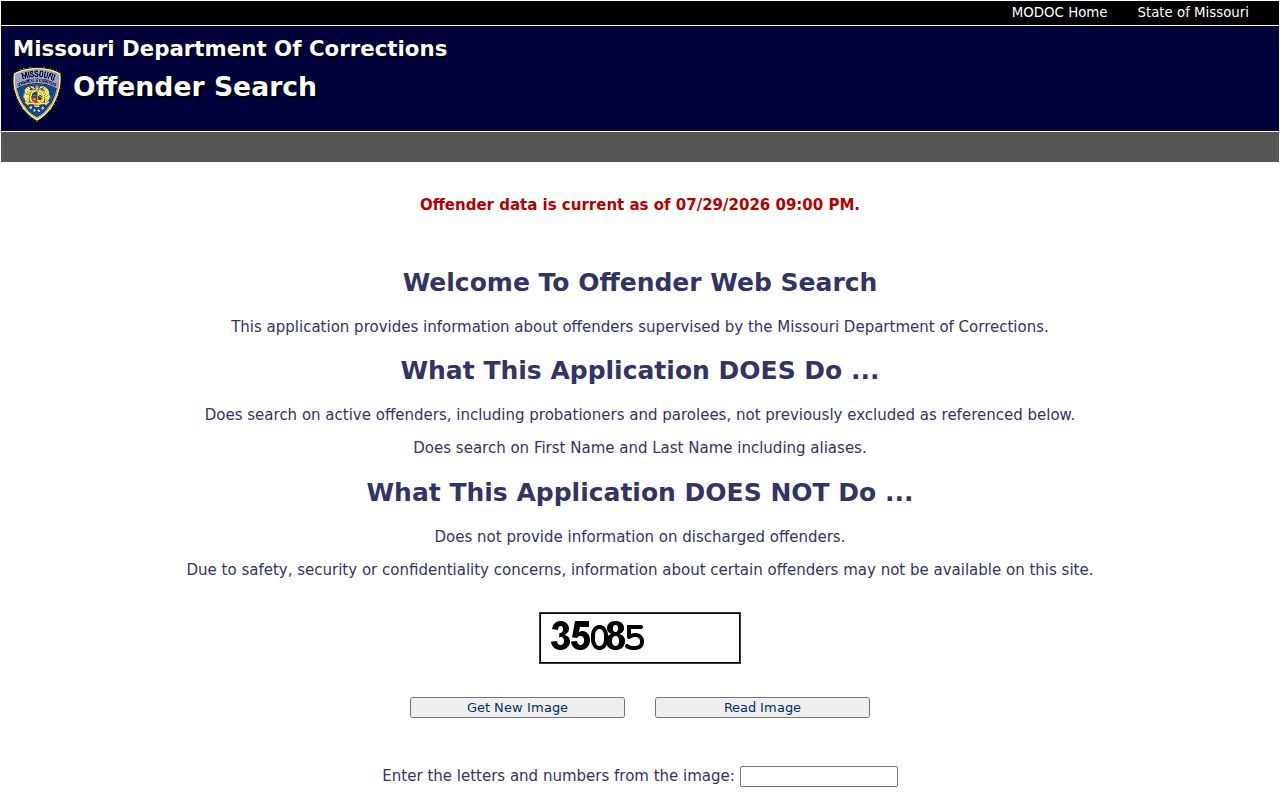
The separate search screen illustrates why court status and state custody status must be checked in their own official systems.
Lafayette County Court Access Channels
Use Case.net first for a public index and recent docket activity. For the underlying public document, older material, inspection, copies, or certification, contact the Circuit Clerk by phone, email, mail, or at the Lafayette Hall counter. For city ordinance files, the city municipal clerk may be the needed local contact. A request should name the case number whenever possible and specify the exact filing or judgment sought.
Lafayette County Circuit Clerk
116 South 10th Street
P.O. Box 10
Lexington, MO 64067
660-259-6101
Monday-Friday, 8:00 a.m.-4:30 p.m.
Lafayette.email@courts.mo.gov
The Lafayette County Sunshine request form includes a Circuit Clerk (Courts) routing choice, but court access also follows Missouri judiciary rules. Give enough detail to identify the record and ask for an estimate if copies are required.
Access & Restrictions
Missouri public access does not make every detail open. The Missouri Sunshine Law presumes government records open unless a law closes them, while courts also follow judiciary operating rules. Juvenile matters, victim and minor data, protected-party information, personal identifiers, sealed warrant material, and expunged cases can be withheld or omitted from remote results.
Electronic access may be narrower than the public material available at the clerk’s counter. If a Lafayette County case does not appear, check spelling, location, year, and case number. Then ask the clerk whether the record is older, municipal, not yet indexed, confidential, or closed. An expungement under Missouri law closes qualifying records, but it does not mean a searcher should infer the past event or ask staff to disclose protected data.
Note: A blank name search is not proof that no arrest, municipal matter, closed file, or newly filed Lafayette County case exists.